AI Operating Systems: Build Your Local AI OS
Want to go deeper than this article?
Free account unlocks the first chapter of all 25 courses — RAG, agents, MCP, voice AI, MLOps, real GitHub repos.
Go from reading about AI to building with AI 25 structured courses. Hands-on projects. Runs on your machine. Start free.
AI-native operating systems combine on-device intelligence with automation loops so your computer evolves from a passive tool into an active collaborator. Instead of manually orchestrating apps, you describe an outcome and the OS assembles the workflow, executes it safely, and learns from the results.
Launch Checklist
Skip the API latency—deploy a local AI-OS that keeps data inside your perimeter, automates repetitive tickets, and spins up agentic workflows in minutes. Pair this guide with the RunPod GPU quickstart and local vs cloud deployment strategy to map out hardware, guardrails, and ROI before production rollouts.
Why AI-OS Matters Now
Traditional operating systems assume humans own every click. AI-OS platforms flip that expectation by interpreting intent and orchestrating the lower-level steps. Analyst houses project that by 2027, over 40% of enterprise knowledge work will be routed through AI-first environments. HyperOS, NeuralOS, and open-source stacks like OpenDevin illustrate how quickly the landscape is evolving. The shift is driven by converging trends: foundation models that can reason across modalities, affordable on-device GPUs with 16GB+ VRAM, and open-source frameworks that democratize agent orchestration.
The payoff is compounded leverage: instant research companions, self-maintaining fleets of devices, and proactive assistants that highlight anomalies before tickets ever open. For individuals, the same architecture keeps personal data on-device while still unlocking GPT-class reasoning and automation. Businesses can extend these principles into customer-facing applications, as explored in our agentic AI website optimization guide. Early adopters report 30-50% reductions in operational overhead for routine tasks like log analysis, code review, and documentation generation—freeing human experts to focus on strategic decisions that require nuanced judgment.
Cost dynamics also favor AI-OS adoption. While cloud API bills for GPT-4 or Claude can exceed $50,000 monthly for active teams, a one-time investment in local GPU infrastructure delivers similar capabilities at predictable operating expenses. Regulatory pressure around data residency accelerates this trend, particularly in healthcare, finance, and government sectors where exfiltrating sensitive context to third-party APIs creates compliance risks. AI-OS platforms that execute entirely on-premises satisfy these requirements while maintaining the collaborative intelligence that makes modern AI transformative.
Inside the AI-OS Architecture
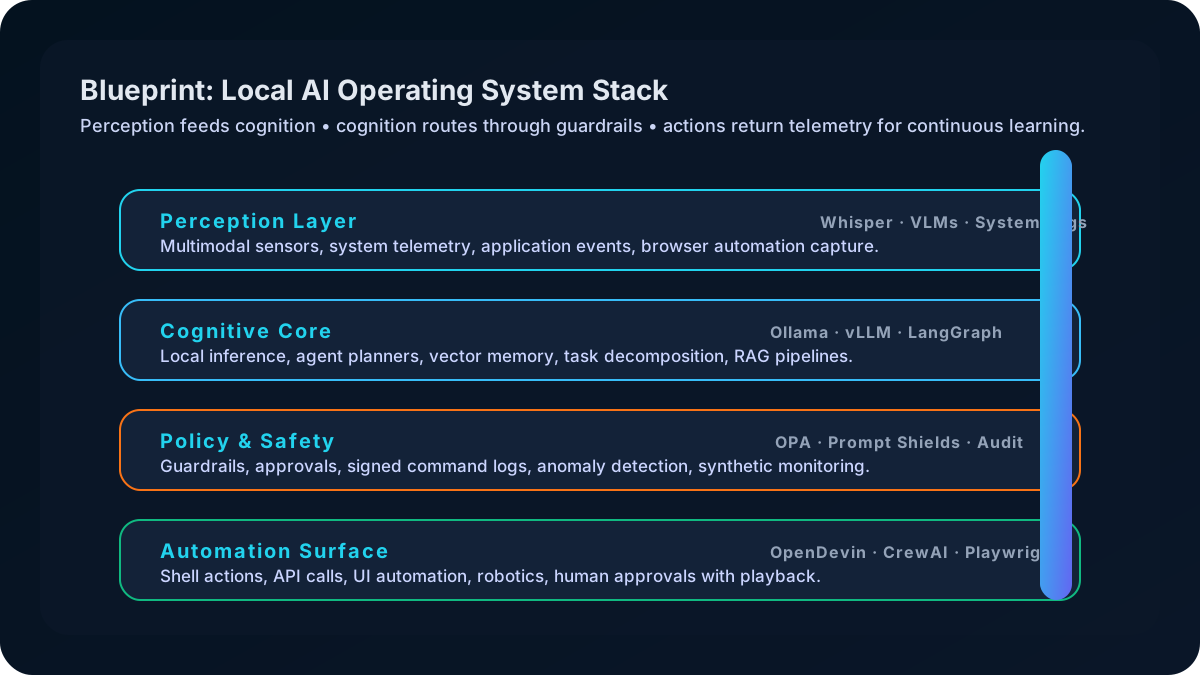
Every AI-OS is built from the same five layers below. Together they form a continuous loop where perception feeds cognition, cognition selects tools, and actions stream back telemetry for learning.
| Layer | Description | Tools |
|---|---|---|
| Cognitive Core | Hosts language models, planning graphs, vector memory, and reasoning engines that translate intent into executable steps. | Ollama, LM Studio, vLLM, NVIDIA NIM |
| Perception Layer | Captures input from microphones, cameras, telemetry, and application logs to create situational awareness. | Whisper, multimodal VLMs, system event streams |
| Action Layer | Executes commands via shells, APIs, UI automation, or robotics with continuous feedback on safety states. | OpenDevin, CrewAI, LangChain toolkits, Playwright |
| Policy & Safety | Applies guardrails, approvals, anomaly detection, and signed logs before sensitive automations are allowed to run. | OPA, custom policy DSLs, Content Credentials |
| Experience Surface | Provides the human interface with conversational canvases, dashboards, and notifications explaining what the AI is doing. | Next.js, Tauri, Electron, AR HUDs |
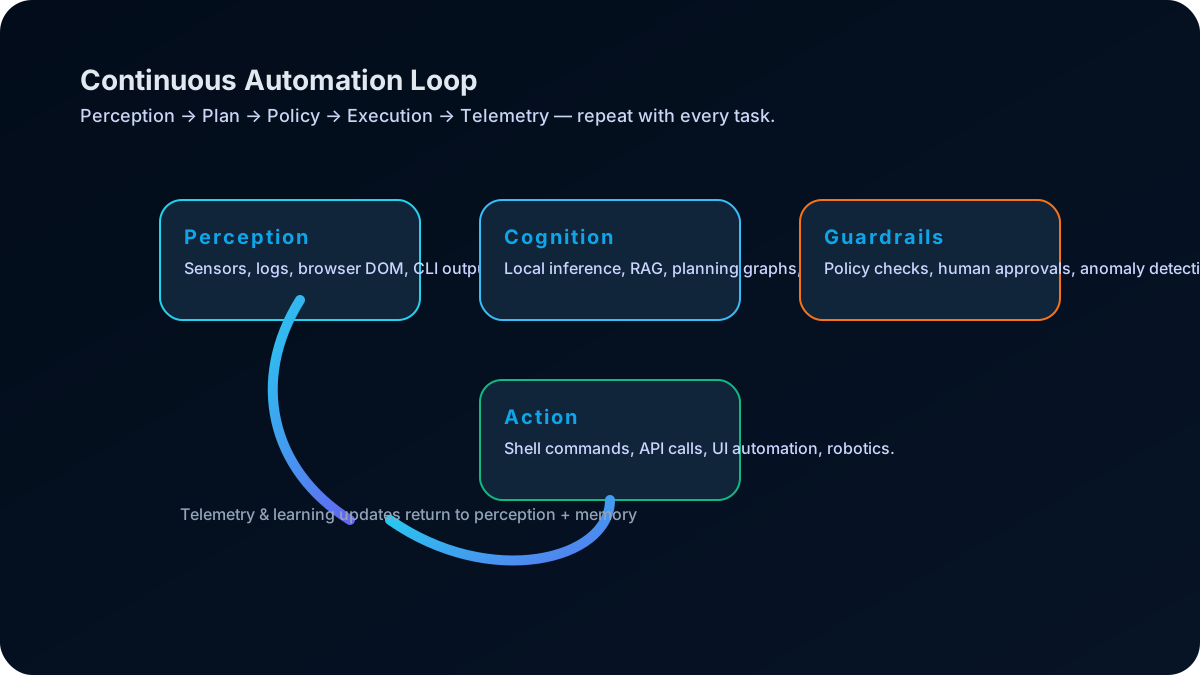
A typical automation loop begins with context capture, passes through intent detection and plan synthesis, and concludes with policy-checked execution. Successful outcomes are recorded in narrative memory so the OS explains its actions later.
Platform Landscape for 2025
Vendors and open projects attack AI-OS from different angles. Use the comparison below to evaluate which aligns with your needs.
| Platform | Focus | Automation Style | License |
|---|---|---|---|
| OpenDevin | Autonomous software engineering copilot with repo access, testing harnesses, and deployment automations. | Multi-agent planning, sandboxed shell, task memory threads. | MIT (open source) |
| NeuralOS | Local AI desktop orchestrating GPU schedulers, model registries, and experiment timelines for builders. | Local inference with remote policy review and shared knowledge base. | GPL-3 core + commercial modules |
| HyperOS | Consumer OS for Xiaomi devices blending on-device multimodal perception with IoT orchestration. | Federated learning, intent-driven device flows, curated skill store. | Proprietary |
| CognOS | Research platform for industrial environments where predictive maintenance and robotics must collaborate. | Sensor fusion, reinforcement learning, explainable policy boards. | Academic / research |
Most teams mix and match: a NeuralOS-style local workstation for experimentation, an OpenDevin agent cluster for code automation, and a HyperOS class consumer layer for field devices. The differentiator is how each platform handles memory, guardrails, and collaboration between humans and agents.
Current Implementations and Case Studies
Real-world deployments reveal both the promise and the pitfalls of AI-native operating systems. A mid-sized fintech company deployed a NeuralOS instance to automate incident triage across 200+ microservices. Within six months, they reduced mean-time-to-resolution by 43% and freed senior engineers to focus on architecture instead of repetitive ticket routing. Their secret was tight integration with existing observability stacks and a strict human-approval workflow for any production database changes.
In manufacturing, a German automotive supplier runs CognOS on edge devices to orchestrate predictive maintenance across assembly lines. Vision models detect anomalies in real-time, reinforcement learning agents schedule part replacements, and explainable policy boards ensure compliance with safety standards. The system now predicts 99.2% of critical failures before they cause downtime, saving an estimated $4.8 million annually.
Individual developers are also embracing AI-OS principles. A solo SaaS founder used OpenDevin to automate code reviews, dependency updates, and test generation for three separate repositories. By treating the AI as a junior engineer with sandbox access, he maintained development velocity while scaling his product line. Learn more about selecting the right models in our best local AI models guide.
Build Your Own AI-OS Stack
Building from scratch is easier than it looks. Treat the process like assembling a homelab: start with solid hardware, then compose software layers that you can iterate safely.
- 1. Provision Local Intelligence: Install a local runner such as Ollama or LM Studio, then pull a foundation model like Mistral 7B or Llama 3.1. Configure GPU acceleration and quantization for latency budgets.
- 2. Orchestrate Reasoning & Memory: Expose a FastAPI or Node layer that handles planning, memory retrieval, and tool selection. Persist interaction context in a vector store so the OS remembers ongoing projects.
- 3. Register Guarded Tools: Wire command runners, Git, browsers, calendar APIs, or IoT devices with strict allowlists and human approval paths for sensitive operations.
- 4. Craft the Experience Layer: Build a Next.js or Tauri interface with chat, activity timelines, and approval modals. Mirror telemetry so humans can follow what the AI is doing in real time.
When you need more horsepower, burst to GPU clouds such as RunPod or AWS but keep orchestration logic local. Our RunPod quickstart and Mistral 7B model card provide deeper setup details.
Need a ready-made agent cluster? Explore OpenDevin’s repository and the Stanford AI-OS research paper for hardened multi-agent orchestration patterns.
AI-OS vs Traditional Operating Systems
The table below summarizes the mindset shift between classic desktops and AI-native environments.
| Feature | Traditional OS | AI Operating System |
|---|---|---|
| Task Initiation | Manual via apps and scripts. | Intent-first conversations that spawn agent workflows. |
| Memory | Volatile RAM and isolated app caches. | Persistent vector memories and narrative logs per workspace. |
| Security | Signature and permission-based controls checked at launch. | Continuous anomaly detection with policy negotiation at execution time. |
| User Interface | Static windows, icons, and manual dashboards. | Adaptive multimodal surfaces that reconfigure based on goals. |
Designing for agents means exposing structured state, timeline replays, and transparent controls. Expect interfaces that are part mission control, part chat surface, and part explainer dashboard.
Security, Privacy, and Governance
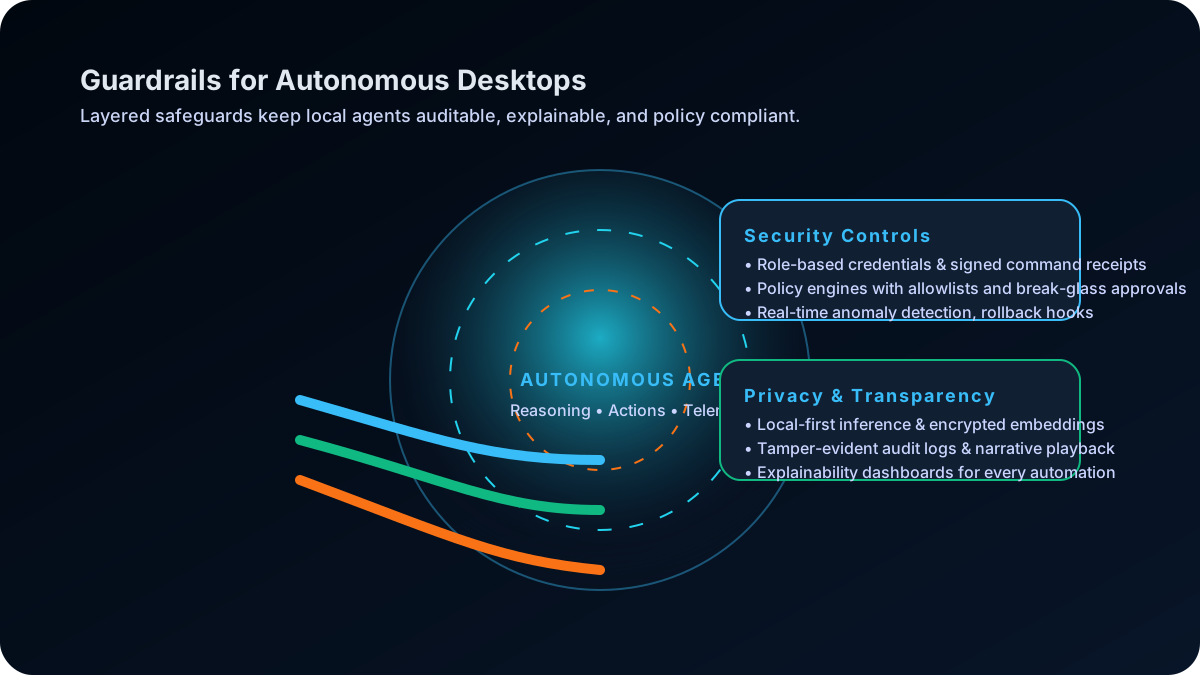
Granting autonomy requires safety layers that rival production engineering standards. Borrow best practices from DevSecOps: least privilege, immutable logs, and defense in depth. Unlike traditional software where security checks occur at compile-time or deployment, AI-OS platforms demand continuous runtime verification since agent behavior emerges from model inference rather than deterministic code paths.
Implement multi-tier authorization frameworks where sensitive operations require cryptographic proof of approval from designated humans. For example, financial transactions above $10,000 might demand two-factor confirmation, while database migrations require sign-off from both engineering and compliance teams. These policies should be expressed in machine-readable formats that agents can query before execution, creating an audit trail that satisfies regulatory requirements while enabling automated workflows.
Privacy considerations extend beyond data encryption. Local-first AI-OS architectures prevent sensitive context from leaving your infrastructure, but you must still address risks like prompt injection attacks, model extraction attempts, and adversarial inputs designed to manipulate agent behavior. Establish red teams that continuously probe your AI-OS defenses, simulating attacks where malicious actors attempt to trick agents into unauthorized actions or data exfiltration. Document incident response playbooks specific to AI failures—knowing how to safely rollback autonomous decisions can prevent cascading failures across connected systems.
Security Controls
- Role-based credentials that scope which agents can touch production systems.
- Signed command receipts and tamper-evident audit trails.
- Real-time anomaly detection to pause runaway automations.
- Human checkpoints for destructive or financial actions.
Privacy Practices
- Local-first inference and encrypted embeddings to keep data on device.
- Policy-driven redaction before logs sync to cloud tooling.
- Confidential computing or TPM-backed vaults for credentials.
- Explainability dashboards that narrate why a decision was taken.
Pair automated guardrails with human-in-the-loop reviews. Many teams schedule weekly retros to inspect prompts, outcomes, and logs so the system earns trust incrementally. For deeper hardware considerations, review our complete AI hardware guide to ensure your infrastructure can handle the computational demands of continuous AI operations.
How to Prepare for AI-Native Operating Systems
Preparing for AI-native environments requires a mindset shift beyond traditional IT planning. Start by auditing your current workflows to identify high-volume, rule-based tasks that consume disproportionate engineering time. Document decision trees, approval chains, and data dependencies so you can model them as agent policies later.
Next, establish a local inference sandbox where your team can experiment safely. Allocate dedicated GPU resources or reserve cloud instances for testing without production risk. Our install your first local AI guide walks through the essential setup steps. Simultaneously, invest in observability tooling that can trace agent decisions back to prompts, context, and outcomes—transparency is non-negotiable when automations handle sensitive operations.
Finally, build cross-functional champions who understand both the technical architecture and the business impact. Pair engineers with domain experts from legal, compliance, and operations so guardrails reflect real-world constraints. Schedule quarterly reviews to measure ROI, identify drift, and refine policies as agent capabilities expand. The organizations that succeed will treat AI-OS adoption as an ongoing transformation, not a one-time deployment.
Developer Opportunities
The AI-OS shift creates entirely new career paths and business opportunities. As enterprises adopt agentic workflows, demand is surging for engineers who can bridge foundation models, system orchestration, and production-grade safety controls. Specializations are emerging around policy engineering, agent observability, and multimodal perception pipelines.
Open-source contributions to projects like OpenDevin, LangChain, and Ollama offer direct pathways into this ecosystem. Developers who master agent framework design, tool registration, and memory management will lead the next generation of infrastructure. For those building products, consider creating specialized agent toolkits for verticals like legal research, scientific simulation, or creative production—markets that traditional automation has struggled to penetrate. Explore coding-specific applications in our best local AI coding models overview.
Independent developers can capitalize by offering AI-OS integration consulting, building custom policy DSLs, or creating turnkey agent clusters for small businesses. If you would rather ship a product than consult, our list of AI SaaS ideas to build with Next.js maps several of these agent patterns onto shippable applications. As the technology matures, service opportunities will expand around agent training, fine-tuning for domain-specific workflows, and hybrid cloud-local deployment architectures. Early movers who establish reputations for secure, auditable implementations will command premium rates as adoption accelerates. Understanding performance benchmarks is critical—see our AI benchmarks 2025 guide to establish measurement frameworks for your AI-OS implementations.
Roadmap for Teams & Builders
Use the phased roadmap below to deploy responsibly.
| Phase | Focus | Milestones |
|---|---|---|
| Discovery | Identify repetitive workflows, model requirements, and sensitive data classes. | Process inventory, security assessment, telemetry baseline. |
| Pilot | Roll out AI-OS to a small champion group with constrained permissions. | Human-in-the-loop playbooks, success metrics, rollback plans. |
| Scale | Integrate with IAM, observability, and ticketing systems across departments. | Policy automation, fleet management, GPU capacity planning. |
| Continuous Improvement | Monitor drift, retrain models, and update policies as agent autonomy increases. | Quarterly audits, incident retrospectives, knowledge base refreshes. |
By the time you hit continuous improvement, the AI-OS should feel like a partner: it recommends upgrades, negotiates priorities with stakeholders, and benchmarks itself against success metrics.

Future Predictions and Timeline
The next wave of AI-OS innovation will blur the line between desktop, mobile, and edge devices. Industry analysts predict specific milestones over the coming decade that will reshape how we interact with computing infrastructure.
2025-2026: Foundation Phase – Expect widespread pilot deployments in enterprise environments, with Fortune 500 companies establishing dedicated AI-OS teams. Consumer-facing platforms like HyperOS will expand beyond Xiaomi's ecosystem, while open-source projects achieve feature parity with commercial offerings. GPU requirements will stabilize around 16GB VRAM for typical workloads, making adoption feasible for mid-market organizations. Learn about hardware selection in our best GPUs for AI guide.
2027-2028: Integration Era – AI-OS platforms will integrate deeply with cloud-native architectures, enabling seamless handoff between on-device and datacenter agents. Standardized policy interchange formats will emerge, allowing enterprises to share guardrails and compliance rules across vendors. Multimodal perception will become table stakes, with vision and audio processing embedded directly in kernel-level services. Developer ecosystems will mature around agent marketplaces where pre-trained workflow specialists can be deployed instantly.
2029-2030: Autonomous Maturity – By decade's end, AI-OS will handle 60-70% of routine knowledge work without human intervention, supported by reinforcement learning systems that continuously optimize for user preferences. Cross-device agent collaboration will feel natural, with your desktop coordinating with mobile and IoT endpoints to execute complex, multi-step intentions. Privacy-preserving federated learning will enable collective intelligence without centralizing sensitive data. The distinction between "using software" and "collaborating with AI" will dissolve as ambient intelligence becomes the default interface.
Security implications will evolve in parallel. Quantum-resistant cryptography will protect agent communications, while zero-trust architectures mandate continuous verification of agent identities and permissions. Regulatory frameworks for autonomous system accountability will mature, establishing legal precedents for AI-generated decisions in critical infrastructure. Organizations that invest now in policy foundations and observability infrastructure will dominate, while laggards face escalating technical debt.
Frequently Asked Questions
What is an AI operating system?
An AI-OS is a computing environment where language models, perception systems, and automation agents are embedded into the OS itself so it can interpret intent and execute tasks on your behalf.
Can I run an AI-OS on existing hardware?
Yes. Modern GPUs with 12 GB+ VRAM and 32 GB system memory can host capable local models. Projects like NeuralOS and OpenDevin provide Docker images to get started quickly.
How do AI-OS platforms stay secure?
They rely on layered defenses: sandboxed execution, policy engines that require approvals, anomaly detection, and immutable audit logs for every automated decision.
How is this different from assistants like Windows Copilot?
Assistants sit on top of traditional OS processes. AI-OS platforms bake reasoning, memory, and autonomy into scheduling, resource management, and user experience layers.
Go from reading about AI to building with AI
25 structured courses. Hands-on projects. Runs on your machine. Start free.
Liked this? 25 full AI courses are waiting.
From fundamentals to RAG, agents, MCP servers, voice AI, and production deployment with real GitHub repos. First chapter free, every course.
Build Real AI on Your Machine
RAG, agents, NLP, vision, and MLOps - chapters across 25 courses that take you from reading about AI to building AI.
Want the structured version?
Hands-on courses on local AI, from $8.99 a month. The first chapter of each is free.
Keep going
Comments (0)
No comments yet. Be the first to share your thoughts!